
The International Cricket Council has torn up the old World Cup blueprint. New formats for the Men’s Cricket World Cup 2027 and the Men’s T20 World Cup 2028 were approved at the ICC’s Annual General Meeting in Edinburgh, and both tournaments will look noticeably different from the last time fans watched them.
The changes affect how teams qualify, how many matches actually matter, and how likely it is that India and Pakistan face off more than once. For a sport where dead rubbers have become a real problem, the ICC is betting this new structure fixes it.
What Happened?
The ICC Board approved recommendations from its Chief Executives’ Committee covering the formats of both the Men’s Cricket World Cup and the Men’s T20 World Cup. The goal, according to the ICC, was to create more meaningful contests and raise the competitive stakes throughout each event.
Both tournaments keep their team counts. The ODI World Cup stays at 14 teams, and the T20 World Cup stays at 20. What’s changing is the road to the final.
Key Details: 50-Over World Cup 2027
South Africa, Zimbabwe, and Namibia will co-host the 2027 Men’s Cricket World Cup, and the tournament will feature a new three-stage format.
- Round 1 – Super Series: The three lowest-ranked qualified teams play a round-robin, and only the winner advances to the next stage.
- Round 2 – Group Stage: The remaining 12 teams split into two groups of six, playing a round-robin. The top three from each group, plus the next best-placed team overall, move on to the Super 7.
- Round 3 – Super 7: Seven teams play a round-robin, and the top four qualify for the semi-finals, with first playing fourth and second playing third.

Notice what’s missing: quarterfinals. The old knockout round is gone, replaced by a bigger round-robin stage designed to keep more teams alive for longer.
Read Also: Pakistan Set To Debut Trio In Bangladesh ODI SeriesPakistan ODI debut trio
Key Details: T20 World Cup 2028
The 2028 tournament, co-hosted by Australia and New Zealand, keeps its 20-team field but restructures the middle of the competition.
- Group Stage: Teams are split into five groups of four instead of the previous four groups of five. The top two from each group advance to the Super 10.
- Super 10: Two groups of five play round-robin. The group winners go straight to the semi-finals.
- Eliminators: A new stage decides the final two semi-final spots, with second-place teams from each Super 10 group facing third-place teams from the opposite group.
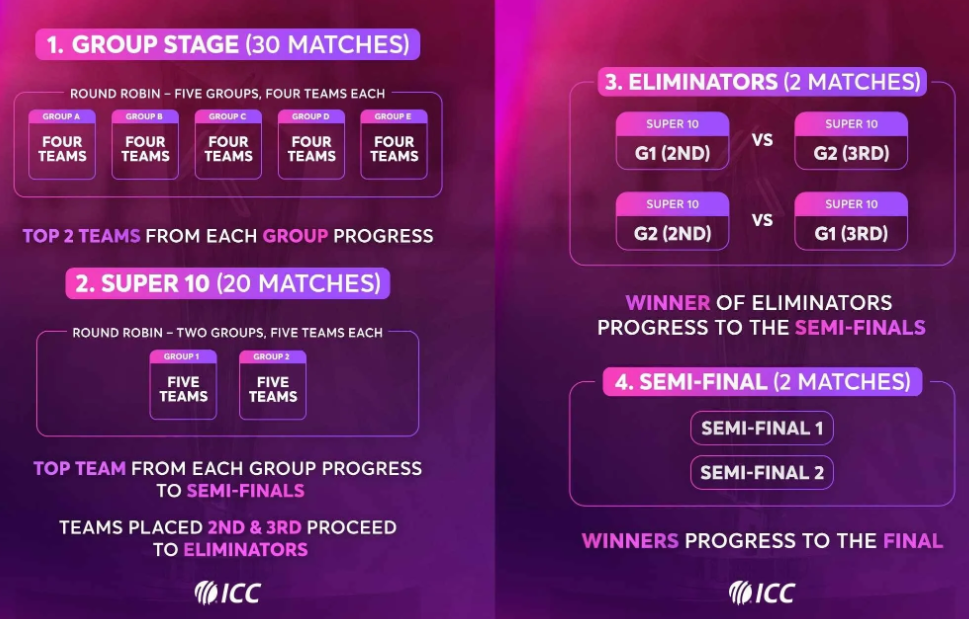
That’s 10 teams reaching the Super 10 stage instead of eight, giving smaller cricketing nations more matches that actually count.
Why It Matters
The biggest storyline for fans in India and the US isn’t the group-stage math, it’s the India-Pakistan angle. An additional team in the ODI round-robin phase raises the chances of an extra India-Pakistan match, still the most lucrative fixture in the sport, and one the ICC is keen to schedule given the two boards’ refusal to play bilateral series.
There’s also a business reason behind this. The restructure follows concerns about too many dead rubbers, sparse crowds, and lopsided results at the recent T20 World Cup. Fewer meaningless matches should mean better broadcast numbers and fuller stadiums deeper into each tournament.
T20 World Cup 2028 Qualification
Twelve teams have already locked in their 2028 spots based on 2026 results and rankings: Afghanistan, Australia, Bangladesh, England, India, Ireland, New Zealand, Pakistan, South Africa, Sri Lanka, West Indies, and Zimbabwe.
The remaining eight spots go through a new 16-team Global Qualifier. Eight teams from the 2026 edition that missed automatic qualification – Canada, Italy, Namibia, Nepal, Netherlands, Oman, UAE, and USA — advance straight into it. Scotland gets a special exemption into the Europe Regional Final rather than the Global Qualifier, due to the unusual circumstances of its 2026 participation.
The other eight Global Qualifier slots come from regional qualifiers: two each from Africa, Asia, and Europe, and one each from the Americas and East Asia-Pacific. From there, the top team in each region plus the next three highest-placed teams overall will qualify for the 2028 World Cup, subject to minimum performance criteria.
Official Statement
This new structure has been endorsed by the ICC Board on recommendation from its Development and Chief Executives’ Committees, but final sign-off is still pending review by the Finance & Commercial Affairs committee at the ICC’s November meetings.
Final Thoughts
Officials will not finalize anything until November, but the direction is clear: the new format reduces dead rubbers, gives underdog nations a longer runway, and creates a structure that delivers more high-stakes India-Pakistan cricket. Whether it actually delivers a more competitive tournament will only be clear once South Africa, Zimbabwe, and Namibia host the first Super Series matches in 2027.

