
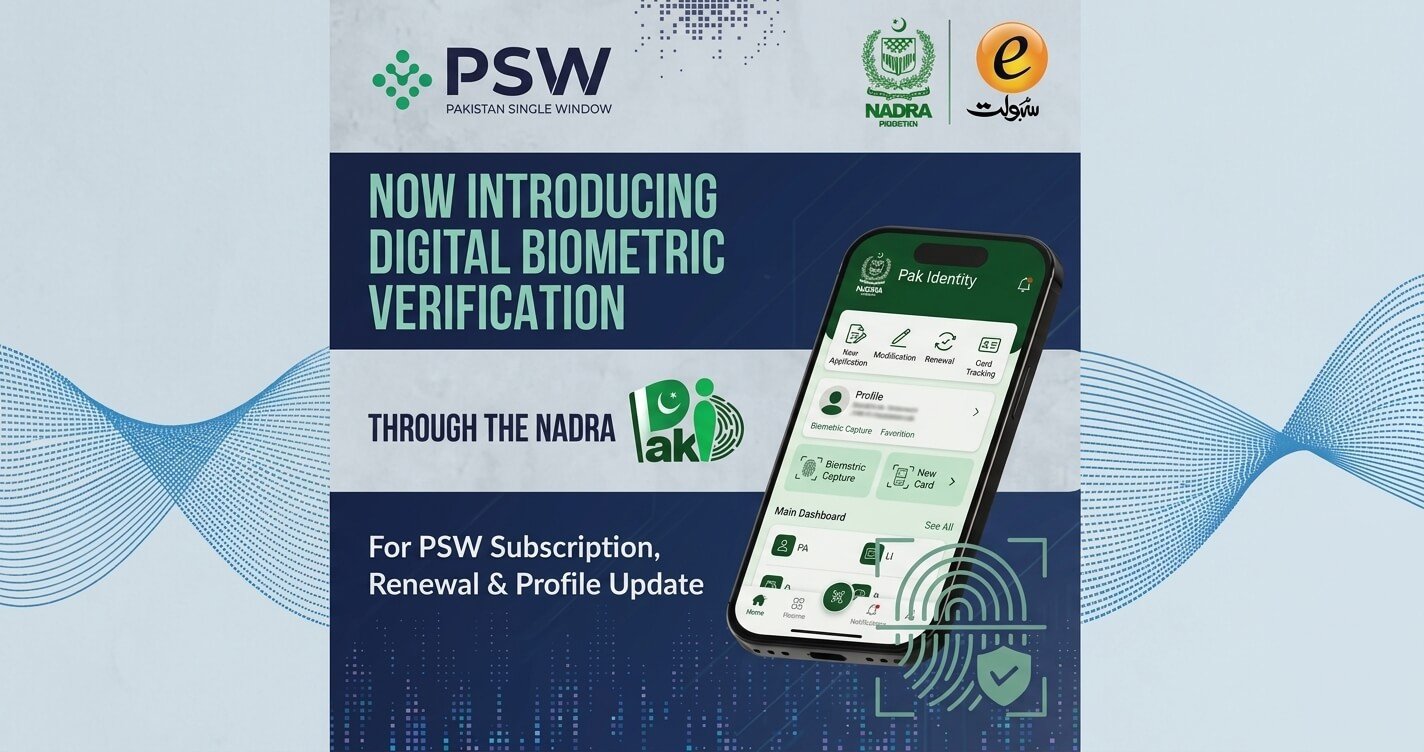
Getting verified for trade services in Pakistan used to mean a trip to a Nadra centre. That step just became optional. The Pakistan Single Window (PSW) has integrated its platform with Nadra’s PakID mobile app, letting users complete mandatory biometric verification straight from their smartphones. No more mandatory visit to an e-Sahulat Centre just to confirm your identity.
For thousands of traders and business owners who rely on PSW for subscriptions and renewals, this removes one of the most inconvenient steps in the onboarding process — especially for those living outside Pakistan.
What Happened?
PSW announced that its platform now connects directly with Nadra’s PakID app for biometric checks. Users can complete verification for new subscriptions, subscription renewals, and profile updates entirely online.
Previously, this was a strictly in-person process. Every user, regardless of location, had to visit a NADRA e-Sahulat Centre for biometric verification before activating or updating their PSW account.
Key Details
- Remote verification: Eligible users can now verify their identity biometrically through the PakID app instead of visiting a Nadra centre in person.
- Applies to multiple processes: The integration covers new subscriptions, subscription renewals, and profile updates.
- Dual option available: Both channels — the PakID app and in-person verification — will run in parallel during a transition period, so users aren’t forced to switch immediately.
- Eligibility rules apply: Remote verification is subject to Nadra’s own requirements, so not every user or use case may qualify automatically.
Why It Matters
This is a big deal for overseas Pakistanis involved in trade. Anyone who has dealt with government verification processes from abroad knows the pain of having to fly back just to complete a biometric check. This update removes that requirement for PSW’s onboarding process specifically. It also shows how Pakistan’s institutions are digitizing services that once required people to visit physical locations, reflecting a broader shift toward modernizing infrastructure in developing digital economies.
Official Statements
PSW CEO Syed Aftab Haider framed the update as a response to user demand, saying the integration reflects the platform’s commitment to listening to its community, both in Pakistan and overseas, and responding to their needs.
He added that the move removes the only remaining physical step in the onboarding process, making the overall experience more accessible.
Read Also: Anthropic Resolves Outage That Hit Multiple Claude AI Models
Availability
The feature is live now for eligible PSW users. Both remote and in-person verification options will remain available during the interim period, according to PSW, giving users flexibility while the system transitions fully to digital-first verification.
Industry Impact
Part of a Bigger Digital Identity Push
This integration sits alongside Nadra’s other recent moves toward mobile-first identity services, including QR-based identity cards and expanded proof-of-life verification through digital channels. Together, these updates point to Pakistan building out a broader digital identity ecosystem — one where Nadra’s infrastructure increasingly underpins services well beyond just national ID cards.
Faster Onboarding for Trade Businesses
For businesses that rely on PSW, faster onboarding could mean fewer delays in starting or renewing trade activity, which matters for a country trying to make cross-border trade processes more efficient.
Final Thoughts
A Small Change With Real Convenience
Removing a mandatory in-person step might sound like a small operational tweak, but for overseas Pakistanis and time-pressed traders, it’s a meaningful convenience. It also signals that more of Pakistan’s bureaucratic processes are likely to move toward app-based verification going forward.
What to Watch Next
Whether this becomes the default experience — or stays a parallel option alongside in-person visits — will depend on how smoothly the remote verification process works in practice over the coming months.

